FAQs
What is management?
There are many definitions of management, and none of them are elegant, but Wikipedia gives us this:
Management (or managing) is the administration of an organization, whether it is a business, a not-for-profit organization, or government body. Management includes the activities of setting the strategy of an organization and coordinating the efforts of its employees to accomplish its objectives through the application of available resources, such as financial, natural, technological, and human resources.
So put simply: the co-ordination of people and resources to achieve outcomes. (People are never "resources" — lest managers become overhead.)
What is the difference between a manager and a leader?
At its simplest, people work for a manager, but they follow a leader. You can be a manager without being a leader, and indeed a leader without being a manager. A leader will favour vision over goals, inspiration over instruction, coaching over directing, and will dig in alongside their team rather than telling them what to do.
The best managers are, at their core, strong leaders who happen to have a management position.
What does a real career ladder look like?
Management — the management of people — is often at complete odds with the job we used to do as individual contributors. It is an entirely different career pathway, and the tools, techniques, and experience we build up in our previous careers don't always prepare us for what it means to be primarily focused on the success and support of those around us.
In the same way that our growth was managed before — active, deliberate practice, reading, practicing, talking, learning — the same is now true of our role in management. But we have to accept that we have joined an entirely new career track.
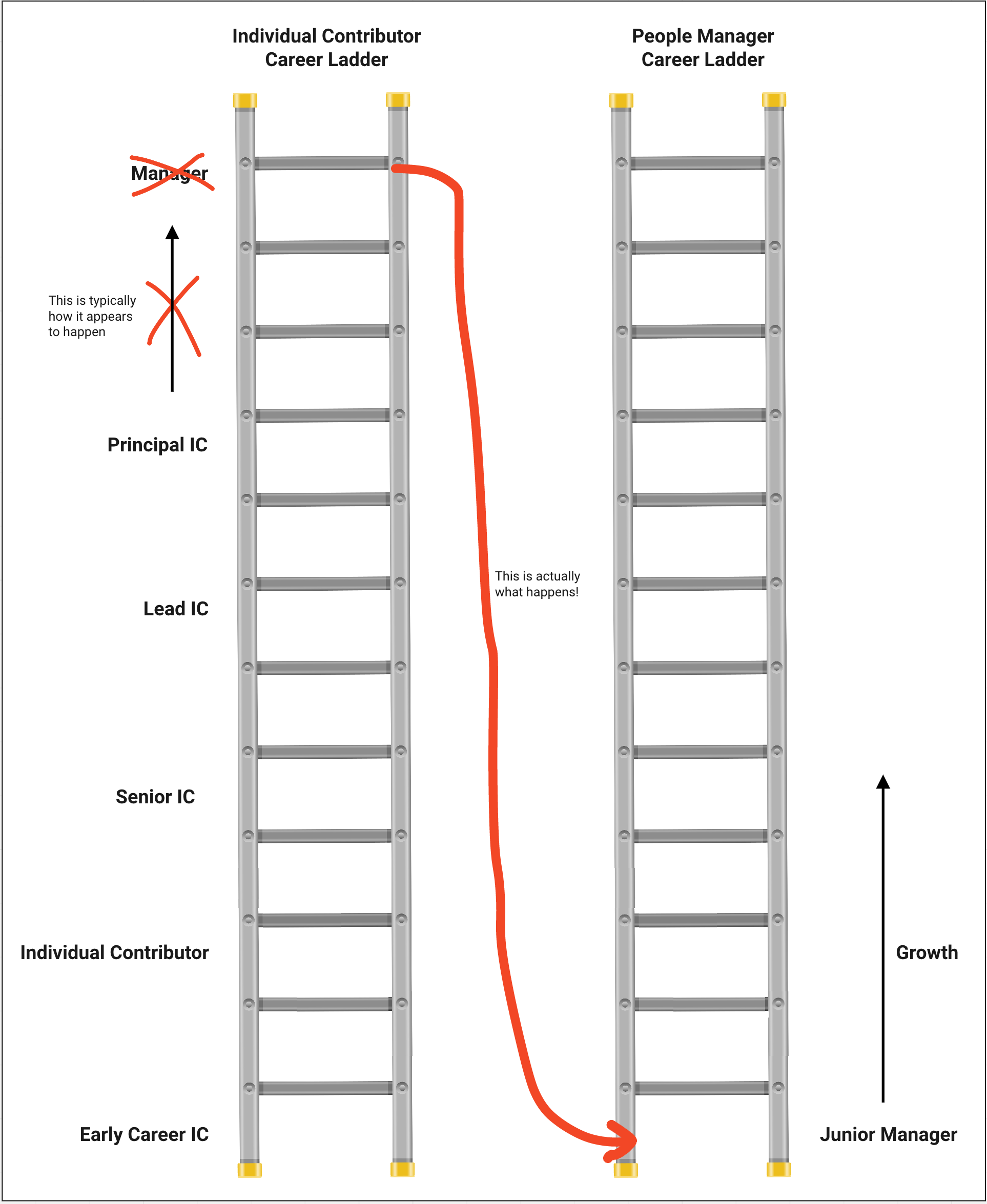
The ladder on the left is typically what we see in people progressing into management: we take our most talented individual contributors and put them in charge of people. This is sometimes a perfect move, and sometimes the worst possible thing we could do. Great ICs don't always make great managers — and indeed you don't have to be the best IC to be effective at management. They're often entirely different disciplines.
Who created the guide?
I'm Terry Brown, and I've been a software engineering lead in some form or another through most of my later career. I performed the role very badly in my early years, and I wish I'd had a structured approach and tool to support the early conversations I had with my own managers, my teams, and to give me some structure for my own growth.
In my later career, I'm driven by creating environments where teams can thrive and do their best work — with a heavy focus on high-performing culture, psychological safety, and continuous improvement.
In my personal life, I'm married and have 3 kids. I am an active LGBT+ ally, my pronouns are he/him, and I enjoy getting away from it all through cycling, running, and more recently rowing.
How can I get in touch?
You can reach me on LinkedIn. I'd love to chat if you are considering using this guide in any way, and I'm always open to discussions around the topics covered here — there is so much I don't know.
How can I use the guide?
I have open-sourced this guide, so feel free to use it, adapt it, grow it, and feed back on it. If you are using it, I'd love to hear from you and see some attribution — a tool is only useful if folks use it.
Can I contribute?
Please! Although I've spent a lot of time reading and digesting information, and have a number of years' experience, I'm the first to admit I have many gaps myself — and these will be manifest within this guide and tooling. The more people I can get to input, the better. Please reach out on LinkedIn and let's have a chat.
How do I start?
Have a quick read of the guide, in particular the start here section. Then load up the tool and make a start.
How long does it take?
I've run through it now with a few people. It tends to take about 30 minutes of pre-reading to understand the various categories, then 30 minutes each from yourself and your manager for scoring, then a 30-minute conversation at the end. About an hour and a half invested in total.
What is the outcome?
At the end of going through this, you should have a more thorough understanding of yourself — your strengths and growth opportunities — with that view correlated with your manager's perspective. This should give you one or two areas to focus your growth activities on.
I need to improve a specific skill — where do I start?
This guide will expand over time to provide links to more targeted resources for each area. As it stands, the resources section is not yet targeted, so a conversation with your manager, some judicious googling, and some reading around the subject is the best starting point.
I have a question that isn't answered here
Please get in touch via LinkedIn — I'd love to engage in conversation on this and grow it over time.